
What Is Market Volatility?
Market volatility refers to the degree to which investment prices rise and fall over time.
According to the Financial Industry Regulatory Authority (FINRA):
“Anyone who follows the stock market knows that some days market indexes and stock prices move up and other days they move down. This is called volatility.”
Higher volatility means prices are changing more dramatically over shorter periods of time.
While volatility can increase investment risk in the short term, it is also a normal characteristic of financial markets.
What Causes Market Volatility?
Several factors can contribute to fluctuations in financial markets.
→ Economic Indicators
Reports on inflation, employment, and economic growth often influence investor expectations.
→ Geopolitical Events
Global conflicts, trade disputes, and government policy changes can create uncertainty in financial markets.
→ Investor Sentiment
Market movements are often influenced by how investors collectively respond to news, risk, and uncertainty.
→ Trade Policies and Tariffs
Trade tensions or tariff changes can affect global supply chains, corporate earnings, and economic forecasts. Because these policies influence both geopolitics and economic indicators, they can contribute to short-term market volatility.

Why Long-Term Investing Matters During Market Volatility
Market volatility often triggers emotional reactions.
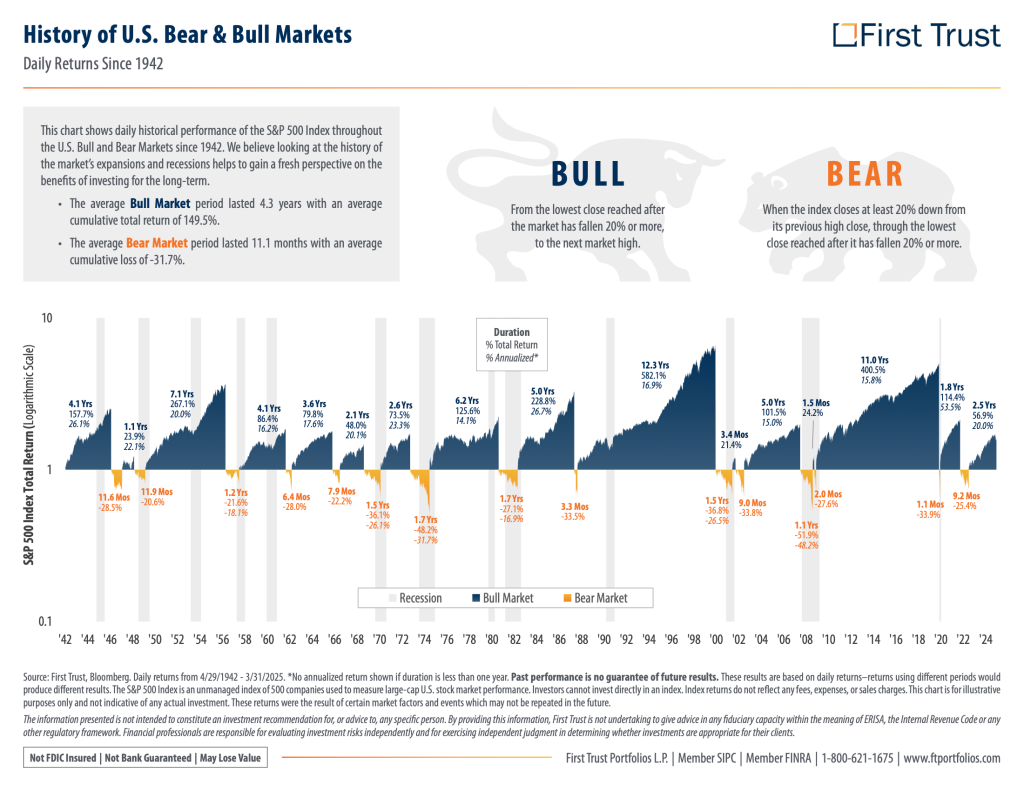
However, reacting to short-term market swings, like selling investments during a downturn, can disrupt long-term investment strategies.
Investors who maintain a long-term investment approach may benefit from allowing their portfolios time to recover during market cycles.
Attempting to time the market consistently is extremely difficult, even for professional investors. Maintaining a disciplined strategy often produces better long-term outcomes than reacting to short-term events.
Aligning Investments With Financial Goals
Investment decisions should reflect personal financial goals rather than short-term market news.
Examples of long-term goals may include:
• retirement planning
• funding education
• starting a business
• purchasing a home
• building long-term financial independence
A thoughtful investment strategy considers:
• risk tolerance (take our Risk Tolerance quiz here!)
• investment timeline
• long-term financial objectives
The most effective investment plans are built around personal goals and time horizons, not short-term market headlines.

4 Strategies for Navigating Market Volatility
Investors often rely on several core strategies to manage market fluctuations.
1. Diversification
Diversification involves spreading investments across multiple asset classes.
Examples may include:
- stocks
- bonds
- commodities
- international investments
- real estate
Because different asset classes often perform differently under various economic conditions, diversification can help reduce the overall impact of market volatility.
2. Dollar-Cost Averaging
Dollar-cost averaging (DCA) means investing a fixed amount of money at regular intervals.
This strategy helps investors:
- maintain consistent investing habits
- avoid trying to time the market
- reduce emotional decision making
Over time, this approach can help smooth out the cost of investments purchased during different market conditions.
3. Portfolio Rebalancing
Over time, market movements can cause portfolios to drift away from their intended asset allocation.
Rebalancing involves adjusting investments periodically to maintain the desired balance between asset classes.
This process helps ensure that a portfolio continues to reflect an investor’s:
- risk tolerance
- time horizon
- long-term goals
4. Tax-Loss Harvesting
Tax-loss harvesting is a tax strategy that involves selling investments that have declined in value in order to offset taxable gains elsewhere in a portfolio.
While this strategy can provide tax benefits in some situations, it must be implemented carefully to comply with IRS rules like the wash sale rule.
Because of these complexities, tax-loss harvesting strategies are often coordinated with financial advisors or tax professionals.