
Blog Title "Navigating Market Volatility: Strategies for Long-Term Investors"

This article is intended for educational and informational purposes only. It does not constitute investment, tax, or legal advice and should not be relied upon as such. All financial, tax, and legal decisions should be made in consultation with qualified professionals based on your individual circumstances. Information in this article reflects conditions as of the date of publication and is subject to change. Citrine & Gold Financial Services is a Registered Investment Adviser registered with the State of Colorado. Registration does not imply a certain level of skill or training.

How to Handle Market Volatility: Strategies for Long-Term Investors

Understanding how to handle market volatility involves recognizing why markets fluctuate, maintaining a long-term investment strategy, and avoiding emotional reactions during short-term market swings. Market volatility is a natural part of investing. Investors who stay disciplined during volatile markets are often better positioned to achieve long-term financial goals.

Quick Answer: How to Handle Market Volatility

When markets become volatile, long-term investors typically focus on four key strategies:

• maintaining a diversified portfolio
• investing consistently over time
• periodically rebalancing investments
• keeping long-term financial goals in focus

Market volatility can feel unsettling, but history shows that markets have experienced cycles of growth and decline throughout modern financial history.

Money chart showing market volatility

What Is Market Volatility?

Market volatility refers to the degree to which investment prices rise and fall over time.

According to the Financial Industry Regulatory Authority (FINRA):

“Anyone who follows the stock market knows that some days market indexes and stock prices move up and other days they move down. This is called volatility.”

Higher volatility means prices are changing more dramatically over shorter periods of time.

While volatility can increase investment risk in the short term, it is also a normal characteristic of financial markets.


What Causes Market Volatility?

Several factors can contribute to fluctuations in financial markets.

→ Economic Indicators

Reports on inflation, employment, and economic growth often influence investor expectations.

→ Geopolitical Events

Global conflicts, trade disputes, and government policy changes can create uncertainty in financial markets.

→ Investor Sentiment

Market movements are often influenced by how investors collectively respond to news, risk, and uncertainty.

→ Trade Policies and Tariffs

Trade tensions or tariff changes can affect global supply chains, corporate earnings, and economic forecasts. Because these policies influence both geopolitics and economic indicators, they can contribute to short-term market volatility.
A Brief History of Market Volatility

Market volatility has occurred throughout modern financial history.

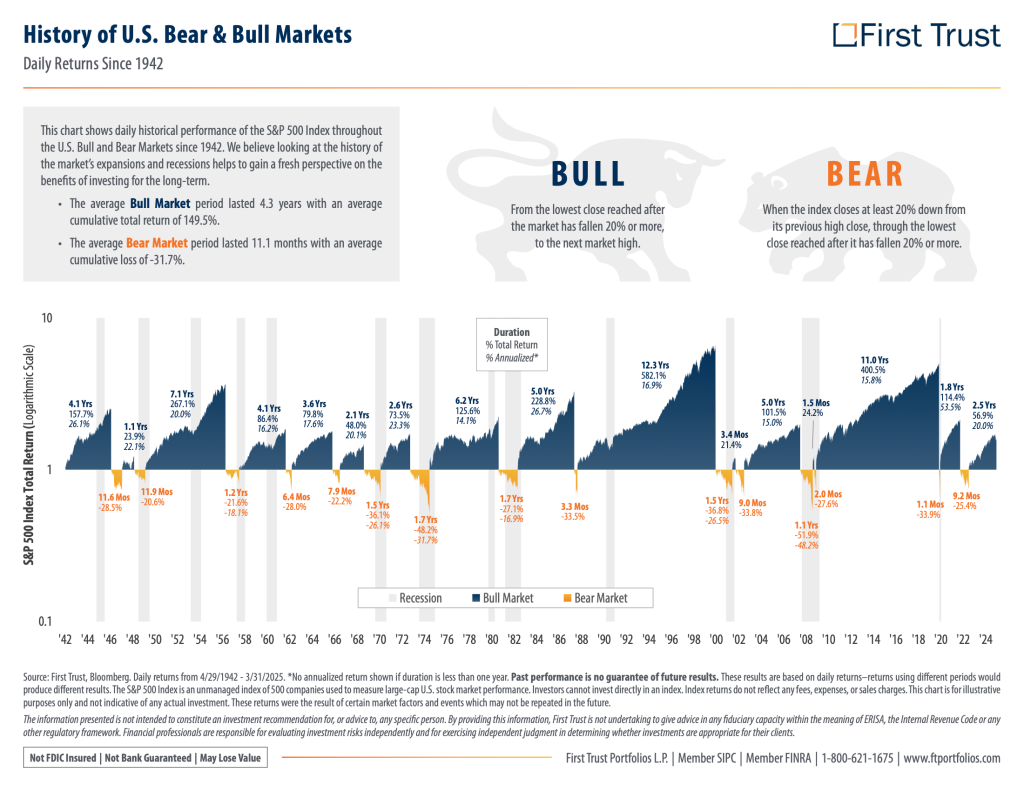
Financial markets move through cycles of bull markets (rising prices) and bear markets (declining prices).

Historical data shows that while downturns can occur quickly, periods of market growth have often lasted longer.

Since 1942:

  • The average bull market has lasted about 4.3 years with an average cumulative return of 149.5%.
  • The average bear market has lasted about 11 months with an average decline of -31.7%.


Understanding these cycles can help investors maintain perspective during periods of uncertainty.


Two street signs that say "Short term" and "long term" pointing in different directions


Why Long-Term Investing Matters During Market Volatility

Market volatility often triggers emotional reactions.

However, reacting to short-term market swings,  like selling investments during a downturn, can disrupt long-term investment strategies.

Investors who maintain a long-term investment approach may benefit from allowing their portfolios time to recover during market cycles.

Attempting to time the market consistently is extremely difficult, even for professional investors. Maintaining a disciplined strategy often produces better long-term outcomes than reacting to short-term events.

Aligning Investments With Financial Goals

Investment decisions should reflect personal financial goals rather than short-term market news.

Examples of long-term goals may include:

• retirement planning
• funding education
• starting a business
• purchasing a home
• building long-term financial independence

A thoughtful investment strategy considers:

• risk tolerance (take our Risk Tolerance quiz here!)
• investment timeline
• long-term financial objectives

The most effective investment plans are built around personal goals and time horizons, not short-term market headlines.

Icons depicting strategies for market volatility

4 Strategies for Navigating Market Volatility

Investors often rely on several core strategies to manage market fluctuations.

1. Diversification

Diversification involves spreading investments across multiple asset classes.

Examples may include:

  • stocks
  • bonds
  • commodities
  • international investments
  • real estate


Because different asset classes often perform differently under various economic conditions, diversification can help reduce the overall impact of market volatility.

2. Dollar-Cost Averaging

Dollar-cost averaging (DCA) means investing a fixed amount of money at regular intervals.

This strategy helps investors:

  • maintain consistent investing habits
  • avoid trying to time the market
  • reduce emotional decision making


Over time, this approach can help smooth out the cost of investments purchased during different market conditions.

3. Portfolio Rebalancing

Over time, market movements can cause portfolios to drift away from their intended asset allocation.

Rebalancing involves adjusting investments periodically to maintain the desired balance between asset classes.

This process helps ensure that a portfolio continues to reflect an investor’s:

  • risk tolerance
  • time horizon
  • long-term goals


4. Tax-Loss Harvesting

Tax-loss harvesting is a tax strategy that involves selling investments that have declined in value in order to offset taxable gains elsewhere in a portfolio.

While this strategy can provide tax benefits in some situations, it must be implemented carefully to comply with IRS rules like the wash sale rule.

Because of these complexities, tax-loss harvesting strategies are often coordinated with financial advisors or tax professionals.

The Role of a Financial Advisor During Market Volatility

Understanding how to handle market volatility is easier with a financial advisor who helps you stay focused on long-term goals. Market volatility can trigger emotional responses that influence investment decisions.

One of the roles of a financial advisor is helping investors maintain perspective during uncertain markets.

Financial advisors may help clients:

  • stay disciplined during market fluctuations
    evaluate long-term investment strategies
  • adjust portfolios when necessary
  • align investment decisions with long-term financial goals


In this sense, a financial advisor often functions similarly to a coach or personal trainer – helping investors remain focused on long-term objectives rather than short-term market movements.

Market Volatility Checklist for Long-Term Investors

During volatile markets, investors often benefit from focusing on a few key principles:

✓ evaluate diversification
✓ continue consistent investing habits
✓ periodically rebalance portfolios
✓ keep long-term financial goals in focus
✓ avoid emotionally driven decisions

These principles can help investors maintain stability during uncertain markets.

group of professional women discussing how to navigate market volatility

Building a Resilient Investment Strategy

Market volatility is an unavoidable part of investing. While short-term market swings can create uncertainty, maintaining a disciplined long-term investment strategy can help investors stay focused on their financial goals.

By combining diversification, consistent investing, portfolio rebalancing, and thoughtful planning, investors can build strategies designed to navigate market fluctuations over time. Knowing how to handle market volatility starts with having a plan before volatility occurs.

At Citrine & Gold, we help align financial planning and investment strategies with each client’s long-term goals and values.

If you’d like to better understand how your investment strategy fits into your broader financial plan, we invite you to schedule a consultation.

Frequently Asked Questions About How to Handle Market Volatility

What is market volatility?

Market volatility refers to the degree to which investment prices rise and fall over a given period of time. Higher volatility means prices are fluctuating more dramatically and more frequently. While volatility can feel unsettling, it is a normal and expected characteristic of financial markets.


What causes market volatility?

Market volatility is typically caused by a combination of economic reports such as inflation and employment data, geopolitical events including trade disputes and global conflicts, shifts in investor sentiment, and changes in trade policy or tariffs. Because these factors are constantly changing, some degree of market fluctuation is unavoidable.


How should long-term investors respond to market volatility?

Long-term investors generally benefit from staying disciplined and avoiding emotionally driven decisions such as selling investments during a downturn. Focusing on diversification, continuing to invest consistently, periodically rebalancing your portfolio, and keeping long-term financial goals in focus are strategies that can help investors navigate volatile markets without derailing their broader financial plan.


Should I sell my investments during a market downturn?

Selling investments during a market downturn is a decision that depends on your individual financial situation, goals, and timeline. However, reacting to short-term market swings by selling can lock in losses and disrupt long-term investment strategies. Historically, markets have recovered from downturns over time. A financial advisor can help you evaluate whether any changes to your portfolio are appropriate given your specific circumstances.


What is dollar-cost averaging and how does it help during volatile markets?

Dollar-cost averaging means investing a fixed amount of money at regular intervals regardless of market conditions. During volatile markets, this strategy helps investors avoid trying to time the market, maintain consistent investing habits, and reduce the emotional impact of short-term price swings. Over time, it can help smooth out the average cost of investments purchased across different market conditions.


How does diversification protect against market volatility?

Diversification involves spreading investments across multiple asset classes such as stocks, bonds, real estate, and international investments. Because different asset classes tend to perform differently under varying economic conditions, a diversified portfolio can help reduce the overall impact of volatility on your investments. Diversification does not eliminate risk, but it can help manage it.


What is portfolio rebalancing and when should I do it?

Portfolio rebalancing is the process of adjusting your investment mix periodically to bring it back in line with your intended asset allocation. Over time, market movements can cause some investments to grow faster than others, shifting the balance of your portfolio away from your original plan. Rebalancing helps ensure your portfolio continues to reflect your risk tolerance, time horizon, and long-term goals. Many investors rebalance annually or when their allocation drifts beyond a set threshold.


What is the difference between a bull market and a bear market?

A bull market refers to a period of rising investment prices, generally defined as a gain of 20% or more from a recent low. A bear market refers to a period of declining prices, generally defined as a drop of 20% or more from a recent high. Since 1942, the average bull market has lasted approximately 4.3 years with an average cumulative return of 149.5%, while the average bear market has lasted about 11 months with an average decline of 31.7%.


How can a financial advisor help during market volatility?

A financial advisor can help you maintain perspective and stay focused on your long-term financial goals when markets feel uncertain. They can help you evaluate whether your current investment strategy still aligns with your goals, risk tolerance, and time horizon, make adjustments to your portfolio when appropriate, and avoid making emotionally driven decisions that could disrupt your long-term plan.

Are You Ready to Build a Resilient Investment Plan?